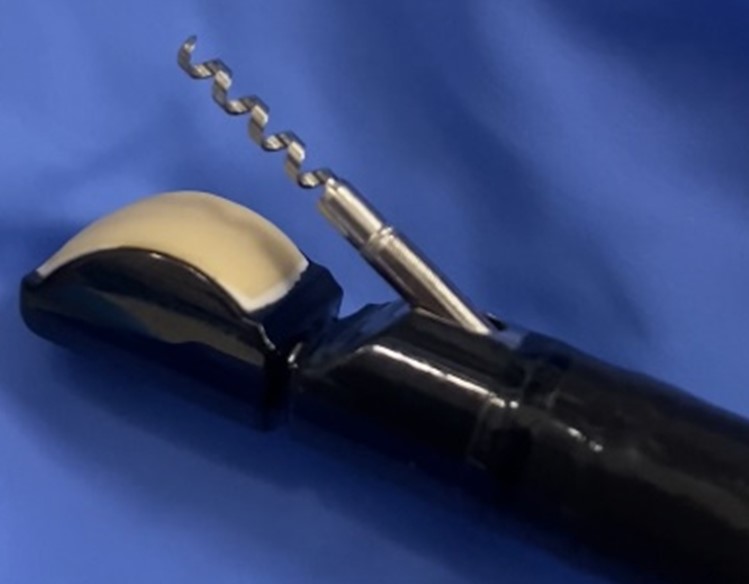

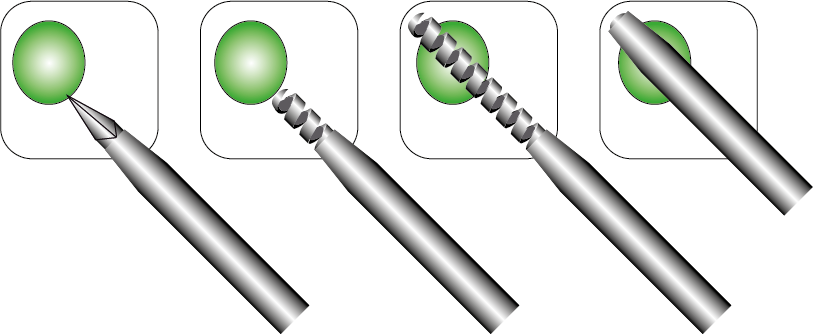
4 simple steps to operate the Spirotome:
1. Position the trocar with cutting cannula up to the target (not for all variants of the Spirotome).
2. Replace the trocar with the receiving needle.
3. Turn the helix into the target (maximally 20 mm)
4. Cut the sample by turning the cutting cannula.

As for all types of cancers, curability increases when lesions are found in an early stage. CT-scan of the thorax is the preferred tool to examine thoracic symptoms. Often, small nodules can be seen at the periphery of the lungs that are out of reach for classical bronchoscopy and too small for transthoracic biopsy. These challenging nodules are often suspect for adenocarcinoma or metastasis. They need biopsy to diagnose cancer and at the same time, to characterize this cancer with histology and molecular biology for optimal treatment. Up to now, only cytology (needle, brush) or very small superficial biopsies (forceps) are possible, but the rate of successful recognizing cancer is not higher than 60 to 70%.
The ScoFlex project 2020 proved that the true positive rate can increase to beyond 90% with full characterization of the biological behavior. The result was the development of the Spirotome Flex: the virtues of the Spirotome mounted on the distal tip of a catheter.
Similar findings were observed in the breast where stereotactic mammography and magnetic resonance imaging (MRI) proved extremely comfortable and safe to guide the Spirotome needle applications. In fact, the Spirotome family of products is the link between early characterization of cancer and cure.
Numerous clinical trials prove that the product is ready to provide a link between early diagnosis and individualized treatment, a way to improve cure rates from less than 20% to over 80%. More scientific information can be found in the list of clinical publications.
Product information is to be found in the catalogue.
In the Eudamed database, the Spirotome family has a
basic UDI-DI: 5407005001035PU